There’s a secret to truly amazing coffee that often gets overlooked, yet it’s right there, sitting in your kitchen: the humble Coffee Grinder. Forget the fancy brewing methods for a moment; if you’re serious about your morning cup, the journey to exceptional flavor begins long before the hot water touches the beans. Freshly ground coffee isn’t just a suggestion; it’s a game-changer, elevating your homebrew experience from simply good to truly unforgettable. A quality coffee grinder gives you the power to unlock the hidden depths of your favorite beans, transforming them into a fragrant, flavorful elixir.
The Heart of the Brew: Why Your Coffee Grinder Matters
Imagine a symphony orchestra trying to play without perfectly tuned instruments. That’s a bit like brewing coffee with inconsistently ground beans. The magic of coffee extraction lies in water dissolving soluble compounds from the grounds. If these grounds aren’t uniform in size, some particles will over-extract, turning your coffee bitter, while others under-extract, leaving it weak and sour. This is why the precision a good coffee grinder offers is absolutely paramount. It ensures an even extraction, allowing every nuanced flavor to shine through, creating a balanced and delightful cup.
Burr vs. Blade: Unraveling the Coffee Grinder Types
When stepping into the world of coffee grinding, you’ll primarily encounter two main types: blade grinders and burr grinders. Understanding their fundamental differences is key to making an informed choice for your daily brew.
Blade Grinders: The Entry Point
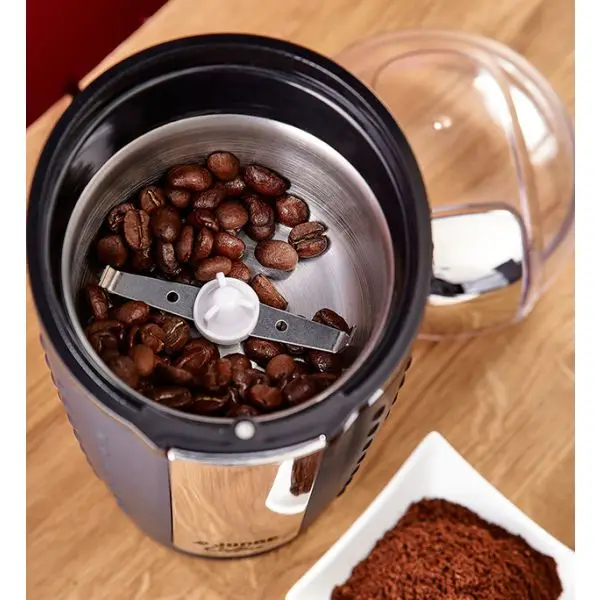
Blade grinders operate much like a small food processor or spice grinder. They use a rapidly spinning metal blade to chop and smash coffee beans into smaller pieces.
- Pros: They are typically more affordable, compact, and simpler to use, often with just a single button operation. This makes them an accessible entry point for beginners or casual drinkers who are not overly concerned with meticulous grind consistency.
- Cons: The primary drawback is inconsistency. Since they chop rather than grind, they produce an uneven mix of fine powder and larger chunks, often referred to as “boulders and fines.” This leads to unpredictable extraction and a less balanced flavor. The high-speed blades also generate heat, which can prematurely warm the beans and diminish their delicate aromas and flavors.
Burr Grinders: The Coffee Lover’s Choice
Burr grinders are the gold standard for anyone serious about their coffee. Instead of chopping, they crush coffee beans between two abrasive surfaces, called burrs, to a precise and consistent size.
- Pros: The most significant advantage of a burr coffee grinder is its ability to produce a highly uniform grind. This consistency is crucial for balanced extraction, allowing the full flavor profile of your beans to develop evenly. Burr grinders preserve the coffee’s flavor and aroma by gently crushing beans at their natural breaking point, minimizing heat generation. They are also incredibly versatile, offering a wide range of grind settings suitable for virtually any brewing method. While often a larger investment, a good burr coffee grinder is built to last for years.
There are two primary types of burr grinders:
- Conical Burr Grinders: These feature two cone-shaped burrs with ridges—one stationary, one rotating—to grind beans with a gravity-chute feed system. Conical burrs are known for being energy-efficient, quieter, and less prone to clogging, even with oily beans. Many popular home burr coffee grinder models use conical burrs.
- Flat Burr Grinders: With flat burr grinders, two horizontally mounted, disc-shaped burrs face each other. Beans are crushed as they pass between these rotating surfaces. High-end flat burr grinders are often lauded by professionals for producing incredibly consistent particles, which can lead to enhanced flavor clarity in the cup. However, they can be trickier to align and may generate slightly more heat.
As coffee expert and veteran barista, Eleanor Vance, often says, “A quality burr grinder isn’t just an appliance; it’s an investment in every single cup you brew. It’s the difference between simply drinking coffee and truly experiencing it.”
Finding Your Perfect Match: A Guide to Choosing a Coffee Grinder
Choosing the right coffee grinder can feel daunting with so many options available. But by focusing on a few key features, you can find the perfect companion for your brewing adventures.
Grind Settings and Brewing Methods
This is perhaps the most critical factor. Different brewing methods demand specific grind sizes for optimal extraction. Your coffee grinder should offer enough adjustability to match your preferred brewing style:
- Espresso (Very Fine): Requires an extremely fine, almost powdery grind to allow for rapid extraction under high pressure. Look for a burr grinder with micro-adjustment capabilities to dial in that perfect shot.
- Pour-Over & AeroPress (Medium-Fine to Medium): A grind similar to table salt or fine sand works best for these methods, providing balanced contact time with the water.
- Drip Coffee (Medium): For automatic drip machines, a medium grind, akin to sea salt, is ideal to ensure even extraction over a longer brew cycle.
- French Press & Cold Brew (Coarse): These immersion methods require a coarse, chunky grind to prevent over-extraction during their extended steeping times and to avoid sediment in the final cup.
Burr Material: Steel vs. Ceramic
The material of your burrs influences durability, heat generation, and price.
- Steel Burrs: Common in both home and commercial coffee grinders, steel burrs are durable and efficient at cutting beans. They can generate a little more heat than ceramic but generally don’t impact flavor in good quality models. They often offer excellent value.
- Ceramic Burrs: Known for running cooler and quieter, ceramic burrs retain their sharpness exceptionally well and have a longer lifespan. However, they can be more brittle and are typically found in more expensive coffee grinder models.
Speed and Heat Control
The speed at which a coffee grinder operates, measured in RPMs, can affect flavor. Lower speed grinders (with lower RPMs) generally produce less static and heat buildup, which helps preserve the delicate flavors of your coffee beans. High-speed grinders might be quicker but can generate more heat, potentially leading to a slightly bitter taste. Most quality residential burr grinders are designed to minimize heat.
Size, Capacity, and Noise Level
Consider your kitchen space. Do you need a compact coffee grinder, or do you have room for a larger, higher-capacity model? If you’re a daily coffee drinker, a larger bean hopper might be convenient. Noise level is also a practical consideration, especially if you’re an early riser and don’t want to wake the whole house. Manual coffee grinders are the quietest option if noise is a major concern.
Budget
Coffee grinders range widely in price. While blade grinders are budget-friendly, a good burr coffee grinder is an investment. You can find excellent entry-level burr grinders that offer significant improvements over blade models, and then there are high-end professional-grade machines. Determine your budget and prioritize features that are most important to your coffee journey.
Keeping Your Grinder Happy: Usage and Maintenance Tips
Your coffee grinder is an essential tool, and like any tool, it needs proper care to perform at its best and ensure your coffee tastes consistently great.
Why Regular Cleaning is Crucial
Roasted coffee beans contain natural fats and oils. Over time, these oils form a sticky film on the burrs and internal surfaces of your coffee grinder. This film can oxidize and become rancid, imparting a stale, bitter, or sour taste to your freshly ground coffee. Furthermore, old coffee particles can accumulate, potentially clogging the mechanism and reducing the grinder’s efficiency and lifespan. This risk increases with darker, oilier roasts or very fine grind settings.
Cleaning Routine
- Daily Maintenance: After each use, empty any remaining beans from the hopper. Run the grinder briefly to clear out residual grounds. A quick wipe-down of the hopper and exterior with a dry cloth will prevent oil buildup.
- Weekly Maintenance: For a more thorough clean, unplug your electric coffee grinder. Disassemble the burr mechanism (refer to your grinder’s manual for specific instructions). Use a soft brush (an old toothbrush works wonders) to clear out larger particles and coffee dust from the burrs and grinding chamber. Wipe away any oily residue with a damp cloth, ensuring all parts are completely dry before reassembling.
- Monthly Deep Clean (or more often for oily beans): Consider using specialized grinder cleaning tablets or pellets. These food-safe granules absorb coffee oils and help dislodge stubborn residues. Simply run them through your coffee grinder like beans, then purge with a small amount of old coffee beans to clear any pellet fragments.
A Critical Warning: Never grind uncooked rice in a burr coffee grinder! While rice might be used in blade grinders to absorb oils, its hardness can damage the precision burrs of a burr grinder, potentially chipping ceramic burrs or misaligning steel ones, which could void your warranty. Stick to manufacturer-recommended cleaning methods or dedicated cleaning pellets.
The Flavor Equation: How Grind Size Unlocks Taste
Understanding the relationship between grind size and extraction is the ultimate secret to unlocking the full potential of your coffee beans.
Coffee extraction is all about surface area. A finer grind means more surface area is exposed to water, allowing for faster extraction of soluble compounds. Conversely, a coarser grind has less surface area, slowing down the extraction process.
- Too Fine = Over-extraction: If your coffee is too fine for your brewing method, water extracts too many compounds too quickly. This results in an “over-extracted” cup that tastes overly bitter, astringent, or muddy. Think of it like squeezing every last drop out of a tea bag until it’s unpleasant.
- Too Coarse = Under-extraction: If your coffee is too coarse, water passes through too quickly, extracting insufficient compounds. This leads to an “under-extracted” cup that tastes weak, sour, or overly acidic, often lacking body and flavor. It’s like steeping tea for only a few seconds.
The goal is to find the “sweet spot” for your chosen brewing method, where extraction is perfectly balanced. This allows for a harmonious release of flavors, aromas, and body. Don’t be afraid to experiment! If your coffee is tasting off, adjust your coffee grinder’s setting slightly coarser or finer and taste the difference. Small changes can lead to significant improvements.
Popular Coffee Grinder Brands & What Makes Them Stand Out
The market offers a fantastic array of coffee grinders, each with its loyal following. Brands like Baratza are often praised for their robust build and consistent performance across a range of grind settings, making them favorites for home baristas. Breville offers feature-rich models like the Smart Grinder Pro, known for its extensive settings and user-friendly interface. Fellow grinders, such as the Ode and Opus, are celebrated for their sleek design and precision grinding for pour-over and drip methods. OXO provides reliable and affordable conical burr options, while Wilfa and Smeg offer stylish and efficient choices.
Frequently Asked Questions (FAQ)
How often should I clean my coffee grinder?
For optimal flavor and longevity, a quick daily clean is recommended. A more thorough deep clean with brushes should happen weekly, and using specialized cleaning pellets or tablets monthly, especially if you use oily beans or grind frequently.
Can I use a blade grinder for espresso?
While technically possible, it’s strongly advised against. Blade grinders produce inconsistent grinds, making it impossible to achieve the fine, uniform consistency required for proper espresso extraction. This will result in an unpredictable and likely poor-tasting espresso shot.
What’s the difference between stepped and stepless grinders?
Stepped grinders have pre-defined notches or “steps” for grind size adjustments, offering a limited number of settings. Stepless grinders allow for infinitely fine adjustments between settings, providing maximum control. Stepless grinders are often preferred by espresso enthusiasts who need to “dial in” their grind with extreme precision.
Are manual coffee grinders good?
Absolutely! Manual coffee grinders, especially those with conical burrs, can offer excellent grind consistency comparable to electric models. They are quiet, portable, and often more affordable for quality burr grinding. The trade-off is the manual effort required, which might not be ideal for large batches.
Why is my coffee bitter/sour?
If your coffee is bitter, it’s likely over-extracted, meaning your grind might be too fine or your brew time too long. Try a slightly coarser grind. If your coffee is sour or weak, it’s probably under-extracted, suggesting your grind is too coarse or your brew time too short. Try a slightly finer grind.
Your Journey to Better Coffee Starts Here
Embracing the world of home grinding with a dedicated coffee grinder is one of the most impactful steps you can take to elevate your daily coffee ritual. It’s about more than just convenience; it’s about control, freshness, and unlocking the true, vibrant flavors hidden within your coffee beans. So, go ahead, experiment with grind sizes, explore different beans, and discover the incredible difference a good coffee grinder can make. Your taste buds will thank you!